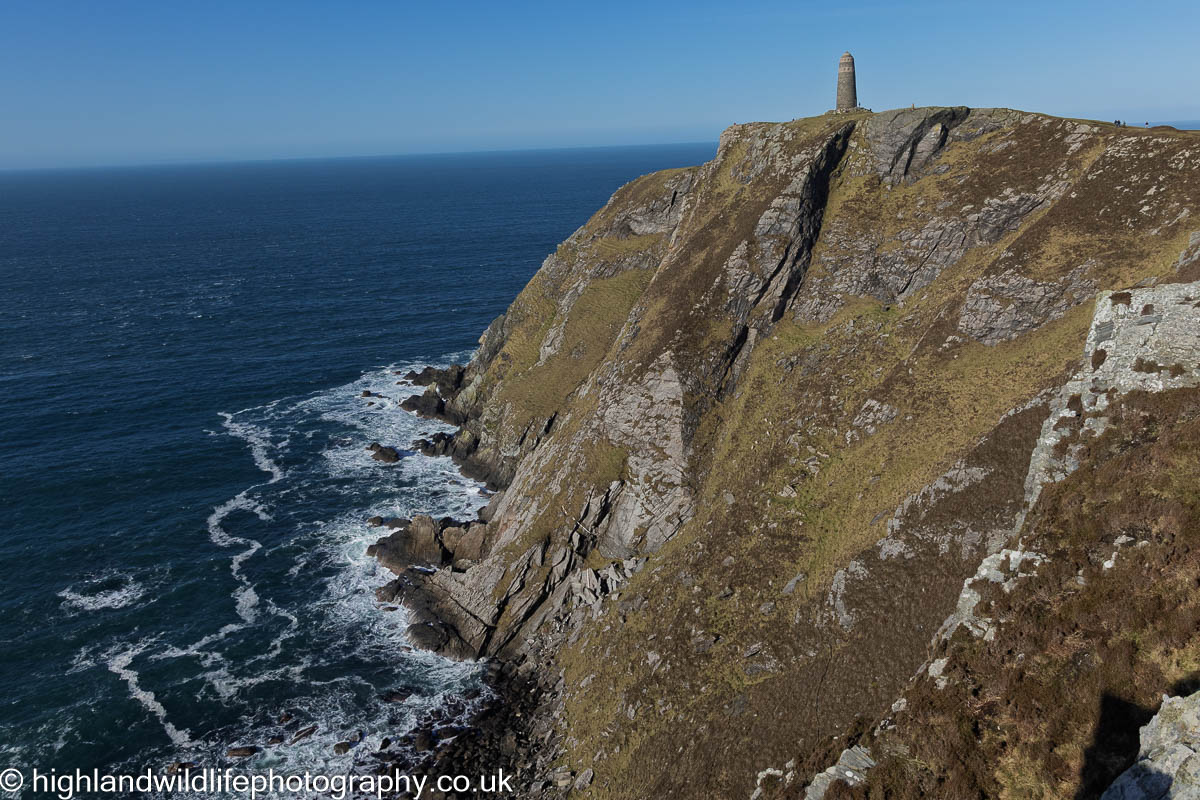
The American Monument on the Oa headland commemorates the American servicemen who lost their lives during two maritime disasters in 1918, specifically the sinking of the Tuscania and the Otranto.
In recent years here in the Highlands at low altitudes a fall of snow that is anything other than wet slush, gone in a few hours has become something of a rarity. Even on the high tops snow now arrives later and cover comes and goes throught the winter. The recent cold snap which came down from the Arctic brought a fall of dry powder snow with frosts that persisted for nearly a week. Ideal conditions to get my camea trap set up. My local boar badger decided to stay at home. However the pine martens remained active unerringly homing in on handfulls of peanuts cached under the snow. At least that was once they had taken the easy option of emptying the squirrel feeders in the garden.
The active lidar beam of the Cognisys Sabre trigger makes pin point focusing and triggering of the camera a breeze. Over four nights I got more than 50 usable pictures. A success rate of around 40%. Missed images were mostly down to heads turned away from camera or buried in the snow.
Photographing a Kingfisher in the Highlands is nor straight forward as they are uncommon this far north in the UK. Locally odd birds occasionally turn up outside the breeding season. At this time of year they are attracted by the large shoals of young River Minnows that frequent the bay on the loch close to my home. Recently a bird turned up and was fishing the shallows. Owing to the low water level of the loch a large expanse of sand and gravel was exposed around the bay leaving nowhere much for the bird to perch close to the waters edge. I soon remedied that by digging in a suitable perch just out into the water. The kingfisher approved as it was already using the perch by the time I had made it back up to the house. Next morning I put up a hide close by. After spending a couple of hours in the hide the kingfisher, a female, alighted on the perch. Several times it flew up a few metres and hovered, head motionless for 10 or 15 seconds before diving down to catch a fish. This was plenty of time for the camera focus to lock on to the hovering bird and get the unexpected bonus of it in flight.
We don’t usually see very much in the way of North American vagrants. Wildfowl on the loch during the winter months are usually just a handful of Goldeneye and Goosanders along with a few Mallards and Teal. Since the middle of November these locals have been joined a couple vagrants from North America, two female Ring-necked Ducks. For the past six weeks they have hardly moved out of the bay in front of the house. Despite being so close to home they have not proved to be the easiest of subjects to photograph. Most of the time feeding offshore out of camera range. They regularly bring up what appears to be the root corms of Quillwort, Isoetes, a primitive aquatic plant genus which occurs on both sides of the Atlantic. Encouraged by the presence of the ring-necked ducks I have made more of an effort to get pictures of some of the other birds on the loch. Getting displaying drake goldeneye in front of my camera has proved no easier than the Ring-necked ducks. Heavily overcast wet weather for most of January only added to the difficulties.
Photographing lichens in winter; as the year moves towards the shortest day and light levels at their lowest lichens are often looking their best. They are not plants but are a symbiotic relationship between fungi and algae which can take many forms. From minute crustose types growing on rocks to much larger foliose and shrubby lichens festooning trees and rocks. The semi-natural woodlands of the Western Highlands, sometimes referred to as the ‘Celtic Rainforest’, have a particularly rich and varied lichen flora. They often grow along with epiphytic mosses and liverworts on trees in such profusion that little bark remains exposed. The lichens best represented in the western woods are the lobarion lichens. A community associated with the more alkaline barked tree species such as ash, elm and hazel. Acid barked species like oak and alder support another less flamboyant community, the parmelion lichens. Whilst it is true that many lichens can appear dull brown or grey in colour some like the foliose Lobarias and the shield like Degelias and Pannarias with their ‘jam tart’ like fruiting bodies provide a splash of colour on a dull winter’s day.
Photographing lichens is relatively straight forward. Close up using a macro lens in low winter light a tripod becomes an essential. Getting sharp images with enough depth of focus has become something of a problem with modern megapixel stacked cameras. An aperture of f11 is past the point at which optical diffraction starts to degrade and soften the image with some cameras. Ways round this are to shoot at wider apertures with shorter focal length lens and maybe to crop the final image. My preferred method is to use a 180mm macro lens at between f5.6 and f8 and create a focus stack of 20 or more images. In the right software the stack can be blended together to produce a front to back sharp subject with nice, defocused background. With my old DSLRs creating a stack used to be a bit of trial and error. Inching the camera and lens on a focus rail to get a series of images to make a stack. These days it’s just a case of setting the right parameters in the cameras stacking programme, pressing the shutter and standing back.
Lobaria virens
Lobarion community - Lobaria virens, amplisima and Pectenia atlantica
Bunodophoron melanocarpum
Burgess jelly lichen - Leptogium burgessii
Collema furfuraceum
Pectenia atlantica with Lobaria amplisima
Pectenia cyanoloma and Nephroma laveagata
P:ectenia plumbea
Fuscopannaria mediterranea
Hypotrachyna sinuosa and Pannaria rugbginosa
Lobaria scrobiculata
Lobarion lichen community
Nephroma laveagata
Normandina pulchella on Pectenia atlantica
Oak Moss, Evernia prunastri with Lecanora pulicaris
Parmotrema crinitum with Pectenia plumbae
Peltigera brittanica
Peltigera membranacea
Platismatia glauca
Pseudocyphellaria crocata
Sticta canariensis
Tree Lungwort - Lobaria pulmonaria
Usnea florida
Wave Lichen - Cetrelia olivitotum
Image copyright David Whitaker Highland Wildlife Photography